May 29, 2026
Deer Industry New Zealand (DINZ) has continued its programme of farmer insights research with a follow-up survey conducted in early 2026, building on the baseline established in 2024.
The survey provides a current snapshot of farmer sentiment, business intentions and industry priorities, contributing to a growing body of data that help inform decision-making and strategy across the sector.
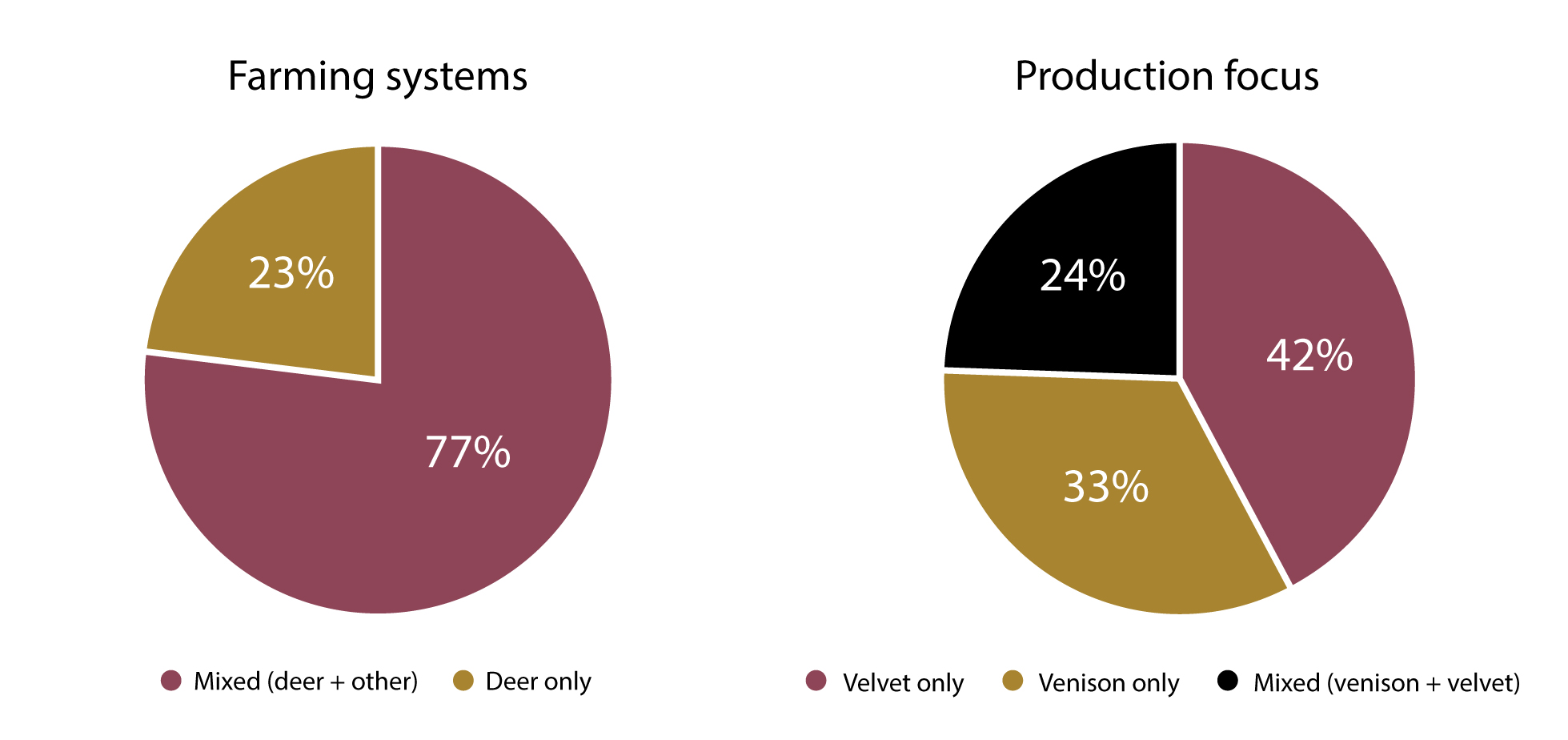
The survey respondents represent a broad cross-section of New Zealand deer farming, with participation strongly reflecting the location of farms. As such, respondents were concentrated in key regions such as Southland (30%), Canterbury (16%), and Waikato (10%). Farming systems predominantly included other species (77%), highlighting the integrated nature of many deer farms. Production focus was spread across velvet-only (42%), venison-only (33%), and mixed velvet-venison systems (24%).
(Numbers may not add up to exactly 100% due to “Prefer not to say” as a possible answer or rounding errors.)
The respondent base also skewed toward experience, with 44% reporting more than 30 years in deer farming, and herd profiles reflecting a relatively large-scale cohort, including a median herd size of 625 animals. Red deer overwhelmingly dominated breed composition (91%).
Herd intentions were relatively balanced across the respondent group, with 22% indicating plans to increase deer numbers, 17% expecting to decrease, and a clear majority (56%) intending to maintain current herd sizes. The key theme, however, was that even amongst those planning to change, most expected only small changes in numbers. Notably, the proportion of farmers anticipating a reduction has dropped significantly compared with the 2024 baseline survey, where 55% signalled a decrease. Among those planning to reduce herd numbers, 26% cited winding down operations due to age or impending retirement.
The cautiously positive outlook was further emphasised by the recent release of herd numbers for 2025. With a slight uptick in herd size for the first time since 2020, it was particularly heartening to see a 3% increase in hinds mated – animals that will be weaned by now.
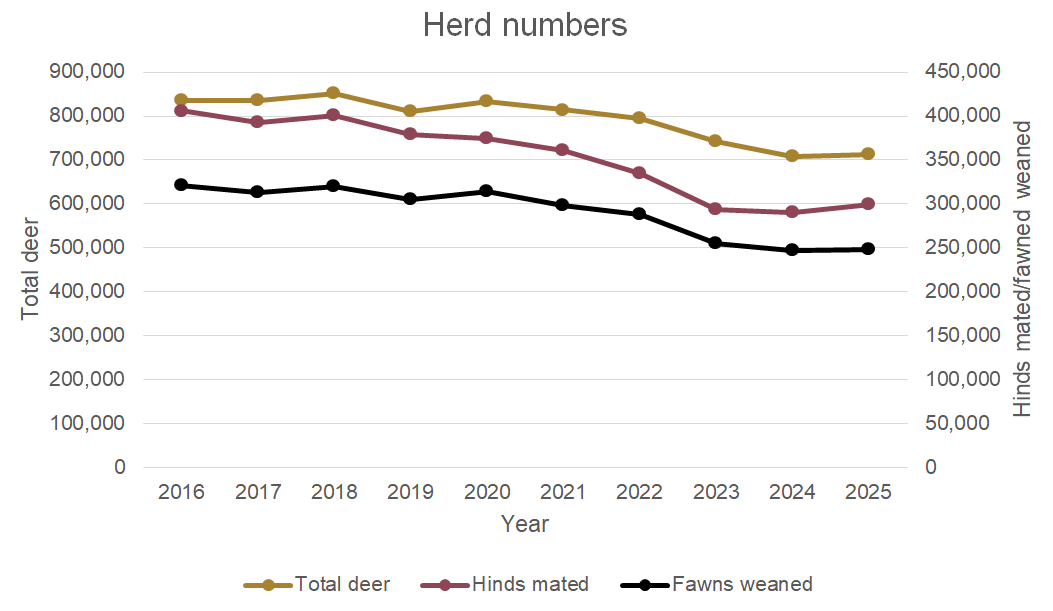
Source: Stats NZ, Agricultural Production Statistics
Much of the survey focused on farmer feedback from the recently concluded Integrated Farm Planning project, which is explored in more detail here.
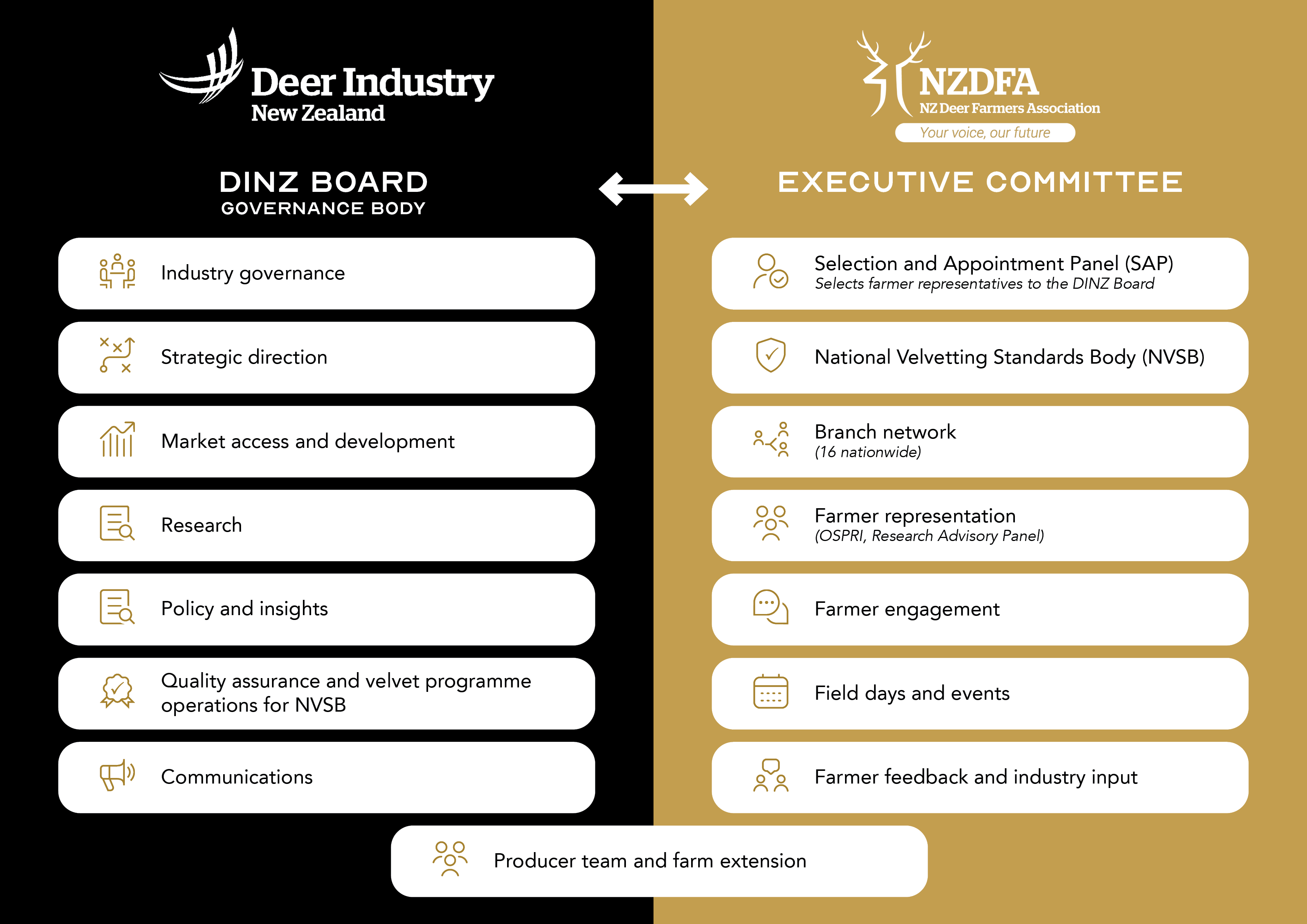
A clear theme emerging from the survey was some confusion around the respective roles of DINZ and the New Zealand Deer Farmers’ Association (NZDFA). While the deer industry is relatively unique, particularly for its size, in having two independant organisations, the findings highlight ongoing uncertainty around how their roles differ, even within the industry.
At a high level, DINZ functions as the industry-good body. Based in Wellington, it focuses on areas such as quality assurance, policy and trade advocacy, market access and development, research, and industry insights, representing the full farmed deer value chain — from farmers through to processors, exporters and marketers. In contrast, the NZDFA is a voluntary, farmer-led organisation with 16 regional branches, dedicated specifically to representing the interests of deer farmers at a grassroots level. Simply put, the NZDFA deals with all things farmer-facing.
Click image to enlarge
While some respondents questioned the efficiency of having two organisations within a relatively small industry, the roles are in practice highly complementary. DINZ undertakes the ongoing engagement with government agencies — often on a weekly or even daily basis — as well as international partners, while the NZDFA focuses on farmer connection and extension, delivering field days and events such as the annual conference and the recent Big Tick Day Out, as well as providing direct, unfiltered feedback from farmers via the respective branches and Executive Committee.
Each plays a role the other would find difficult to replicate, and together they contribute to a more complete and effective industry voice.
A good example of this “one industry” approach would be as part of this insights project, where the DINZ survey was paired with an independent survey done by NZDFA. With more of a South Canterbury/North Otago and Hawke’s Bay response base than the DINZ survey, the NZDFA survey reported 55% of respondents looking to increase their deer numbers versus 45% not; 16% were projecting an increase of 10% or more, 35% less than 10%, and 29% looking to decrease by more than 10%.
The NZDFA survey had a production focus of 42% velvet-only, 29% venison-only and 29% mixed – largely in line with the DINZ survey.
Other farmer feedback in the DINZ survey pointed to a desire for more up-to-date Deer Facts resources, expanded animal health support, and a stronger emphasis on research. Work is already progressing across each of these areas, with the first of the refreshed Deer Facts fact sheets set to be distributed as an insert in the June edition of Deer Industry News. Animal health extension continues to build momentum, following recent Wormwise workshops delivered through the Integrated Farm Planning programme and the strong interest in events such as the Big Tick Day Out.
Farmers highlighted research as a key component in supporting the future success of the industry, with “market-led, science-driven innovation” expected to play an increasingly important role in shaping what comes next, as DINZ CEO Rhys Griffiths said at the annual deer industry conference.
Unsurprisingly, last season’s poor velvet prices emerged as a point of contention, with farmers clearly signalling that returns were below expectations. Feedback also pointed to concerns around grading subjectivity and consistency, as well as the questionable behaviour of some parties in the velvet supply chain. These issues remain a key focus for DINZ, with recent grading guideline discussions also addressing broader themes of supply chain integrity and discipline — areas that are being actively worked on in both the short- and longer-term to support more consistent and sustainable price outcomes.
Taken together, the survey findings point to an industry gaining momentum as it moves away from reliance on a limited number of markets and channels, while remaining clear-eyed about the work still to do. Farmers have been upfront about the pressures they are facing, but there is also a sense that some of the right pieces are starting to fall into place — whether through improved alignment, stronger focus areas, or momentum in key parts of the system. Ultimately, the goal remains clear: returning more value to the farm gate, driven by better value capture and stronger positioning of New Zealand farmed deer products in premium markets globally.