May 1, 2026
Earlier this month, DINZ was invited to the official launch of HENKIV IMMUNE, an immune-enhancing health functional food product developed by leading Korean pharmaceutical company, Yuhan Care. This followed many years of close collaboration with New Zealand and provided the opportunity for a wider market visit to our core stakeholders in both China and South Korea.
It was a privilege to witness firsthand the results achieved, and esteem held for my DINZ colleagues and Bioeconomy Science Institute senior scientist, Dr Stephen Haines. Without New Zealand’s leadership, research expertise and dogged determination over many years, it is highly unlikely that Korean pharmaceutical companies would have the foundation from which they are now building a portfolio of health functional food claims based around New Zealand velvet.
The South Korean economy has surged 1.7 percent in the first quarter of 2026, and this was palpable as I worked my way through meetings across Seoul. People were out and about in their droves spending money. The Korean R&D investment was evident from the skyline view at the Yuhan Care HENKIV launch event of world leading technology and innovation companies. In addition, South Korea is a dominant force in semiconductor design and manufacturing and are major beneficiaries of the insatiable appetite for artificial intelligence across the globe.
In South Korea, the official launch of HENKIV IMMUNE provides an exciting new platform for health functional food claims, with a pipeline of further research applications underway. KGC reported it had growth in its key velvet brand over the last year, combined with its significant investment in Lunar New Year advertising and a new product launch targeting the youth demographic. This suggests our future partnership prospects at the innovative end of the New Zealand velvet spectrum remain solid.
At the other end of the spectrum, just an hour's flight across the Yellow Sea in China, the softness in consumer confidence was tangible in the meetings I had in the northeast of the country, which is traditionally a less developed region of China. China has a tricky juggling act ahead with AI. It wants to stake out a global leadership position but is mindful of the technology’s impact on already reported high youth unemployment rates, which was raised in various conversations. Some commentators did suggest that the slowdown in visible spending was influenced by the traditional Chinese mindset around saving for a rainy day, as well as China’s greater uptake of online shopping habits.
In the traditional medicine market, meetings with Korean traders and traditional medicine channels shone a light on the interdependence and dominance of Chinese export channels. There was appetite in both South Korea and China to create improved traceability systems to help combat illegal and/or unethical supply chain behaviour. In China, local sika velvet commands a premium, so their interest was in aligning more closely to our traceability system but maintaining differentiation of country of origin.
Meanwhile, in Korea, I learned how historically Russian velvet has commanded a premium in traditional markets, though I was surprised by the rationale. It is quite simply a belief that because Russian deer live in a harsher, colder climate, their survivability, and therefore their antler composition, will in turn provide greater health benefits. However, I was encouraged to hear several stakeholders noting their preference for New Zealand velvet – particularly in emerging contemporary formats – with greater traceability being the main argument.
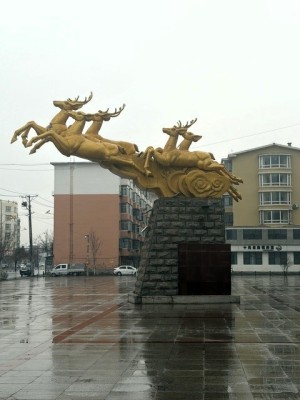
Deer take a place of prominence in Xifeng, as evidenced by the town’s public monuments. (Photo: Terry Meikle)
In China I also met with Beijing Tong Ren Tang – the country’s oldest TCM company – and two of the country's largest donkey skin gelatin companies. This provided an insight into a national China Time-honoured Brand targeting women's skin and beauty products. I can certainly attest to the gelatin content of donkey knee, which was the signature dish served that evening! It was fascinating to learn that these companies are only able to supply 30 percent of their donkey production needs from within China and are sourcing from every corner of the globe. DINZ continues to deepen this partnership following the MoU signing in 2025.
My final stop in China was to the northeast and the entry point for close to 90 percent of our velvet trade. The small town of Xifeng (locally known as Deer City) has a population of 180,000, and it felt like stepping into a time warp. Xifeng is about as far removed from Seoul as you can possibly get, which is what makes the trade puzzle of our New Zealand velvet even more challenging. While I left with more questions than answers, I can say one thing with certainty – the local economy in the small town of Xifeng depends very heavily upon New Zealand deer velvet.
Looking to the horizon, I came away thinking that while there will always be demand for velvet from the traditional medicine sector based on the physical appearance of antlers, at some point the New Zealand deer industry will benefit from transitioning to technology that can prove the compositional attributes of antlers. This will require an investment into AI and tech vision science and innovation, which is quickly evolving. Over time, this approach will be demanded by pharmaceutical and/or health food companies wanting more sophisticated scientific evidence and world-class traceability. If we can combine that with a quantum leap in traceability technology, we will tighten the supply chain and deepen trust and partnerships. This will position our industry well to improve future farmgate profits.
With 90 percent of current trade going to China and 65 percent being consumed in South Korea, one prescient Asian stakeholder noted that “not even President Xi Jinping himself could piece together the current deer antler velvet trade puzzle”, so it is clearly an area that requires a more coordinated effort to drive supply chain integrity, both at home and abroad.
By Terry Meikle, DINZ Markets Manager